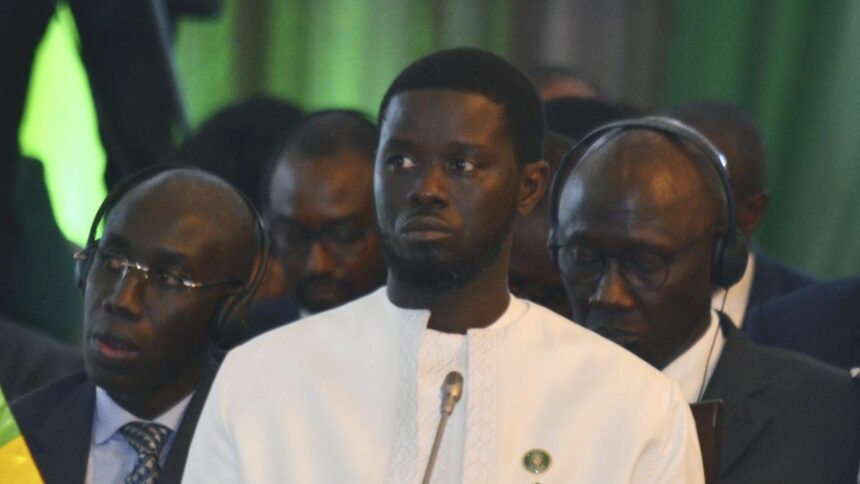
Senegal’s Bassirou Diomaye Faye, Africa’s youngest president, now confronts a formidable task: uniting a regional bloc that predates him and is currently fraught with challenges.
On Sunday, 44-year-old Faye was assigned the crucial task of reintegrating Mali, Niger, and Burkina Faso into ECOWAS during a summit in Abuja, Nigeria’s capital. These countries had exited ECOWAS and formed their own alliance after military coups disrupted their ties with neighboring West African nations.
Supported by Togolese President Faure Essozimna Gnassingbe, Mr. Faye is seen as the ideal leader to restore regional cooperation. Despite the potential benefits of security and economic collaboration, ECOWAS has lost some of its appeal in recent years, according to Afolabi Adekaiyaoja, a research analyst at the Center for Democracy and Development in West Africa. However, this new role provides Mr. Faye with an opportunity to push for reforms aimed at creating “a more sustainable and self-reliant ECOWAS,” Adekaiyaoja said.
Mr. Faye’s leadership contrasts sharply with the military rulers’ agenda. He was not in office when ECOWAS, established in 1975, imposed severe sanctions on Niger following a coup last July. Niger cited these sanctions as a reason for its departure from ECOWAS. Furthermore, Mr. Faye’s recent election, which was confirmed as credible, stands in stark contrast to the rigged elections in the region.
Domestically, Mr. Faye is reassessing long-standing alliances that military leaders claim have hindered West Africa’s development. Senegal remains a key Western ally, but under Mr. Faye, the government is renegotiating contracts with foreign companies to “free us from the ties of dependency in our public policies,” according to Finance Minister Abdourahmane Sarr.
Analysts believe this approach aligns with the junta’s objectives. Since overthrowing democratic governments in Mali, Burkina Faso, and Niger, the military leaders have severed military and economic ties with traditional Western partners like the United States and France, arguing that these relationships have not benefited their countries. This shift has allowed Russia to increase its presence in the region.
“Like other heads of state, he claims sovereignty and a break with the old order,” said Seidik Abba, a Sahel specialist and president of the International Center for Reflection and Studies.
Although Mr. Faye is Africa’s youngest president, he is older than three of the region’s four current military leaders. At the ECOWAS meeting in Nigeria on Sunday, he was still one of the youngest leaders present.
During his visit to Nigeria in May, Mr. Faye emphasized his age as an “asset” that could help open dialogue with his neighbors. However, Mr. Abba noted that engaging with the three countries would be challenging, as they have broader concerns about ECOWAS, accusing it of foreign interference from countries like France, their former colonizer.